
The object
Study the gold surface, the inscription and the cross. Photographs and measurements bring the object’s craftsmanship into focus.
Examine the disc
THE CURMSUN DISC · A MEDIEVAL TREASURE
A small gold disc bearing the name of Harald Bluetooth. Discover its medieval world through Sven Rosborn’s research and the history preserved by the Sielski family.
 LOOK CLOSER. THE STORY IS IN THE DETAILS.
01 / THE OBJECT
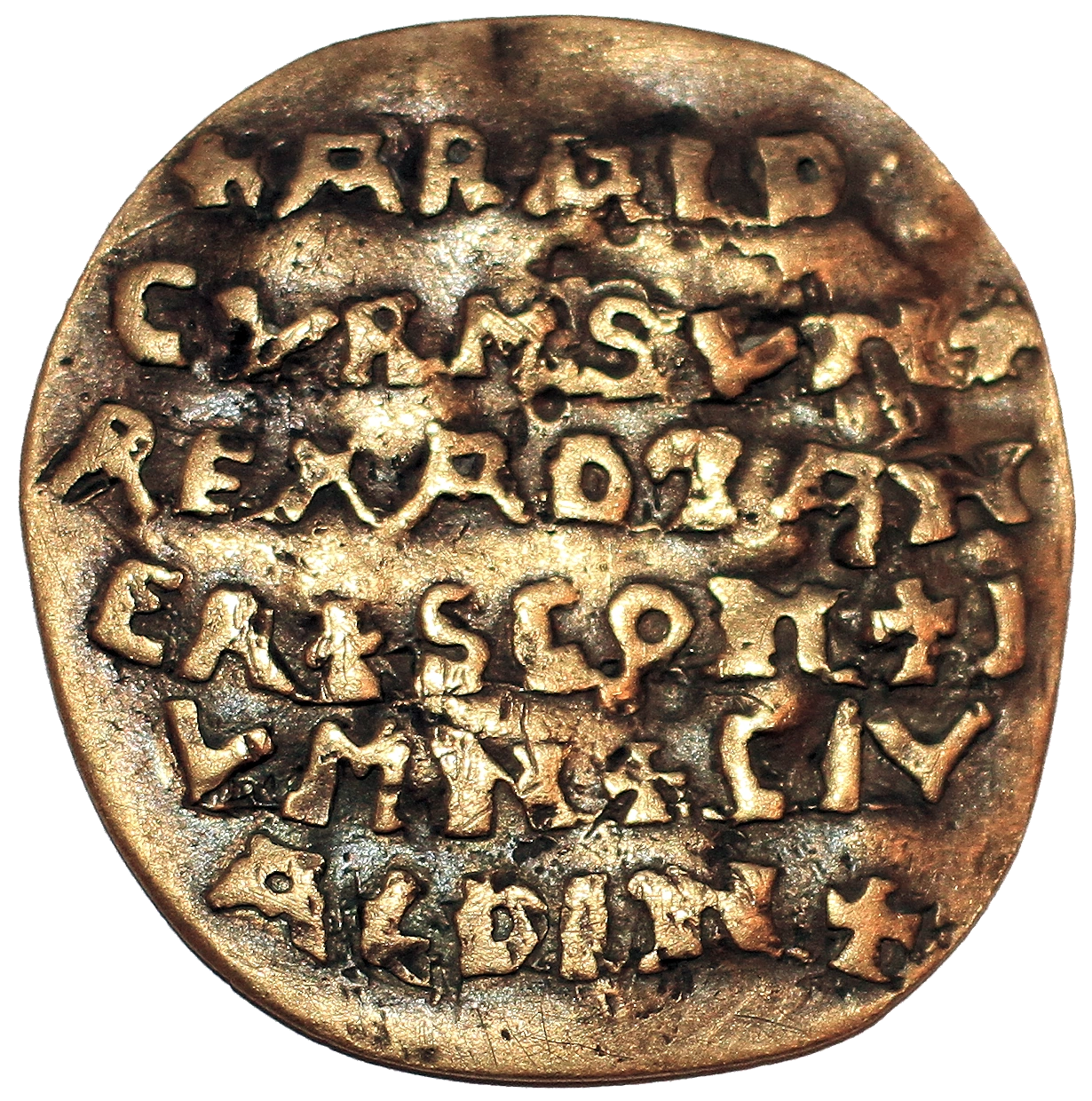
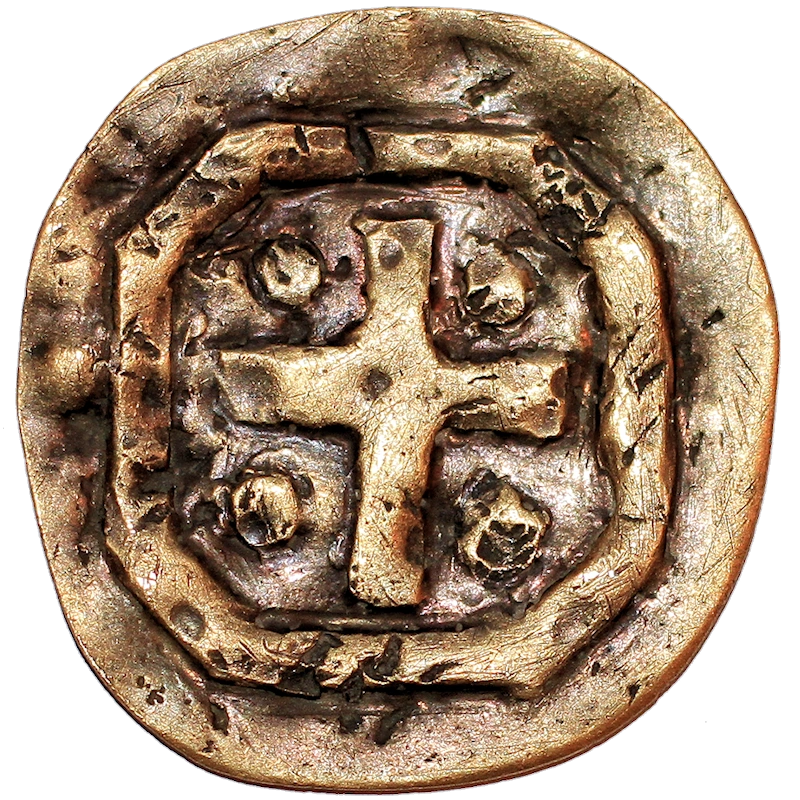
One side bears the name Harald Gormsson. The other carries a cross within an eight-sided border. Together, the inscription and symbols lead into the Christian world of medieval Scandinavia and the southern Baltic.
This exhibition presents the Curmsun Disc project’s perspective through Sven Rosborn’s research. In his interpretation, the disc belongs to the historical setting of Harald Bluetooth’s death in the late 10th century.
The historical interpretation and measurements presented here follow Rosborn’s published account. The project also reports a helium-dating result of 1,030 ± 400 years. [3]
Select a side · Click the photograph to enlarge


02 / THE DISCOVERY
In autumn 2014, the disc resurfaced among the Sielski family’s belongings in Sweden. Julia Sielski passed it to her older sister Maja, who brought it to a history teacher. Archaeologist Sven Rosborn then began investigating its story. [1]
The journey leads back to a church crypt in Pomerania. Family documents and memories carry the story from the nineteenth century, through the upheavals of 1945, to its rediscovery in Sweden.
Baltic-inspired landscape · illustrative artwork, not a documented findspot.
03 / A TRAIL THROUGH TIME
Follow the disc through the discovery narrative preserved by the family and the research that brought its history to a wider audience.
The family’s published account begins at the ruined church in Groß Weckow, today Wiejkowo in Poland. Twelve-year-old Heinrich Boldt discovers the entrance to a crypt containing the gold disc and other objects. [2]
At the end of the Second World War, Polish army major Stefan Sielski and his brother Michael take possession of the treasure in Pomerania. The disc becomes part of the family history later carried to Sweden. [2]
Julia and Maja Sielski brought renewed attention to an object kept by their family. Its lettering prompted questions that carried it beyond the family home and into historical research. [1]
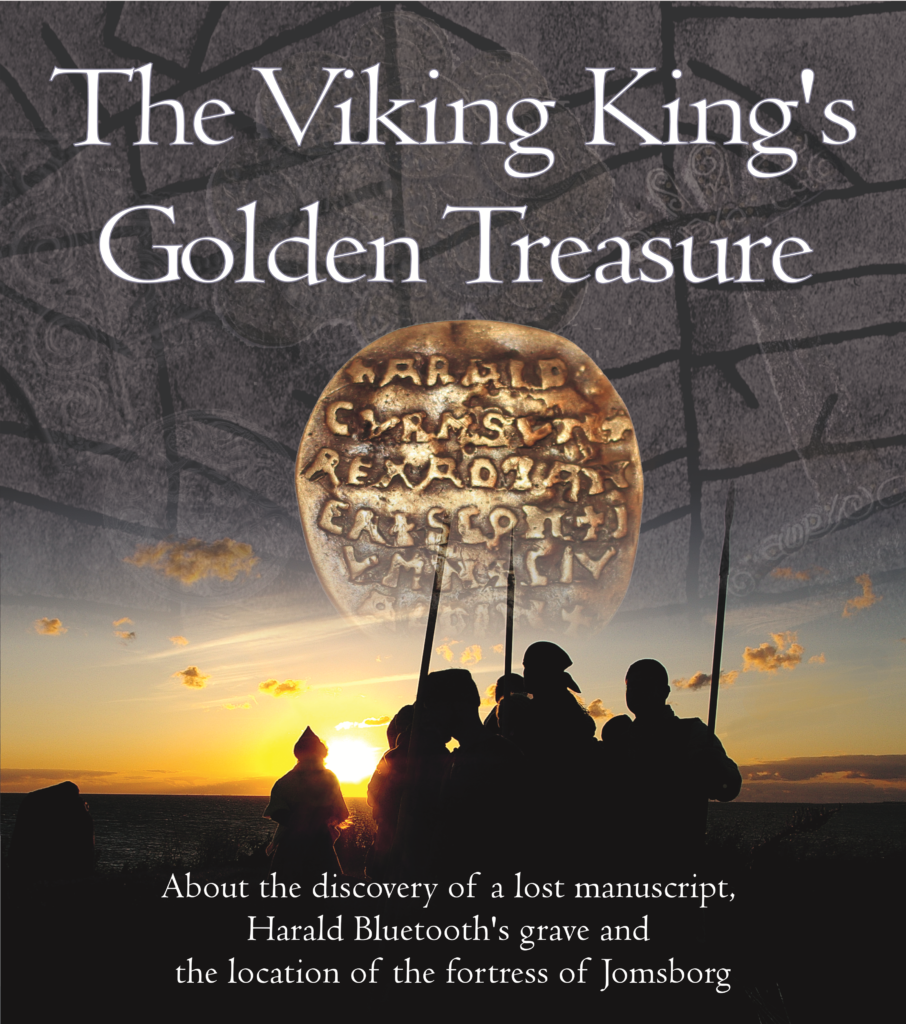
Sven Rosborn publishes The Viking King’s Golden Treasure, bringing together his research on the disc, Harald Bluetooth, the manuscript known as Gesta and the history of Jomsborg. [3]
FROM THE PROJECT ARCHIVE
04 / READ THE INSCRIPTION
Follow the inscription through the names and places in Rosborn’s reading of the disc. Each detail opens another part of Harald Bluetooth’s Baltic world.
Line breaks follow the original website’s transcription. The explanations present the historical reading used by this project. [1] [7]
Harald: the king whose name stands at the beginning of the inscription. In Rosborn’s interpretation, this is Harald Bluetooth.
Interpreted as Gorm’s son: Gormsson. The disc’s modern name comes from these letters.
Usually read as a reference to a king of the Danes. The unusual wording is one reason the inscription rewards close study.
Interpreted as Scania, in the southern part of present-day Sweden.
Jumne, associated with Wolin and the history of Jomsborg, connects the inscription with the southern Baltic setting central to Rosborn’s research.
Aldinburg, identified in this reading with Oldenburg in Holstein, places the inscription within the network of Christian centres around the Baltic.
05 / THE HISTORICAL HORIZON
At Jelling in Denmark, a royal inscription offers a powerful point of comparison. Harald’s great rune stone, raised around 965, commemorates his parents Gorm and Thyra and proclaims his achievements. [4]
The royal name and Christian cross on the Curmsun Disc belong at the heart of this exhibition’s medieval interpretation: a meeting of kingship, faith and remembrance.
Explore the Jelling StoneTHE REVERSE / A CROSS AND FOUR DOTS
The cross places Christian remembrance at the heart of the design.
06 / THE RESEARCH ROOM
Explore Sven Rosborn’s interpretation of the disc, its inscription and its connection with Harald Bluetooth in the late 10th century. The project’s reported helium analysis is presented separately.
Study the gold surface, the inscription and the cross. Photographs and measurements bring the object’s craftsmanship into focus.
Examine the discFollow the family’s account from the crypt in Pomerania to the disc’s rediscovery in Sweden.
Follow the timelineDiscover how the royal name, Christian imagery and Baltic place-names come together in Rosborn’s historical interpretation.
Read the research notesSven Rosborn places the disc in the historical setting of Harald Bluetooth’s death in the late 10th century. His book develops the connection with the king, the chronicle known as Gesta and Jomsborg. This is the principal research perspective presented by the project. [3]
The inscription names Harald Gormsson and links him with the Danes, Scania, Jumne and Aldinburg. Rosborn reads these elements together as a memorial to the king within a Christian Baltic setting.
The project reports a helium-dating result of 1,030 ± 400 years. This result is presented alongside Rosborn’s research into the disc and its connection with Harald Bluetooth. [3]
The ±400 years is the analysis’s stated uncertainty. Rosborn’s late-10th-century dating is a historical interpretation of the disc, its inscription and its context; it is not a conversion of the numerical limits of the helium result.
07 / COMMON QUESTIONS
Rosborn interprets it as a commemorative gold disc linked to Harald Bluetooth. Its royal inscription and Christian imagery are central to the interpretation presented here.
The inscription names Harald Gormsson — Harald Bluetooth. Rosborn connects the disc with the king’s memory and the historical setting of his death in the late 10th century.
The family’s account places the discovery in a church crypt at Groß Weckow, now Wiejkowo in Poland. The full discovery page follows Heinrich Boldt, the Sielski brothers and the disc’s later journey to Sweden.
Yes. Family documents, archival references, photographs and relevant research can enrich the story. Contact the research team with details of your material.
08 / SOURCES & FURTHER READING
Read the publications and project accounts behind this exhibition’s historical perspective. The helium result quoted here comes from information supplied by the Curmsun Disc project.
Original photographs, inscription and the account of the 2014 discovery.
The family’s discovery narrative, from nineteenth-century Pomerania to the events of 1945.
The author’s interpretation of the disc, its history and its proposed connection to Harald Bluetooth. Also the source of the reported measurements.
Historical context for Harald, the royal family and Christian imagery.
Background on Sven Rosborn and the project’s published research.
Rosborn’s early study of the object, its inscription and historical context.
Disc photographs: supplied through the existing Curmsun Disc website, retained here for its redesign. Landscape: AI-generated illustrative artwork. It does not depict an authenticated findspot. Editorial overview prepared October 2026.
THE NEXT CLUE MAY BE IN AN ARCHIVE.
Have a document, a research question or a new perspective? We welcome informed enquiries.